Why Real Conversations Beat Reviews for High-Ticket DTC Brands
Here’s a question I keep coming back to: Would you spend $5,000 based on a 5-star review?
Not five grand on a vacation where you can read TripAdvisor threads and look at photos. I mean a cargo bike. A tiny house. An electric scooter that’s going to change how your family gets around. Something you’ve never touched, never sat on, never loaded your kids into.
You wouldn’t. I wouldn’t either. And yet the entire DTC industry is built on the assumption that stacking enough stars and testimonials on a product page will close the trust gap.
It won’t. Not for products like these.
The Review Gap
Let me be clear: reviews are not useless. They serve a real purpose. If I’m buying a $30 phone case and 4,000 people say it doesn’t crack, I’m good. The risk is low, the decision is reversible, and aggregate sentiment is all I need.
The calculus changes completely when the price tag has a comma in it.
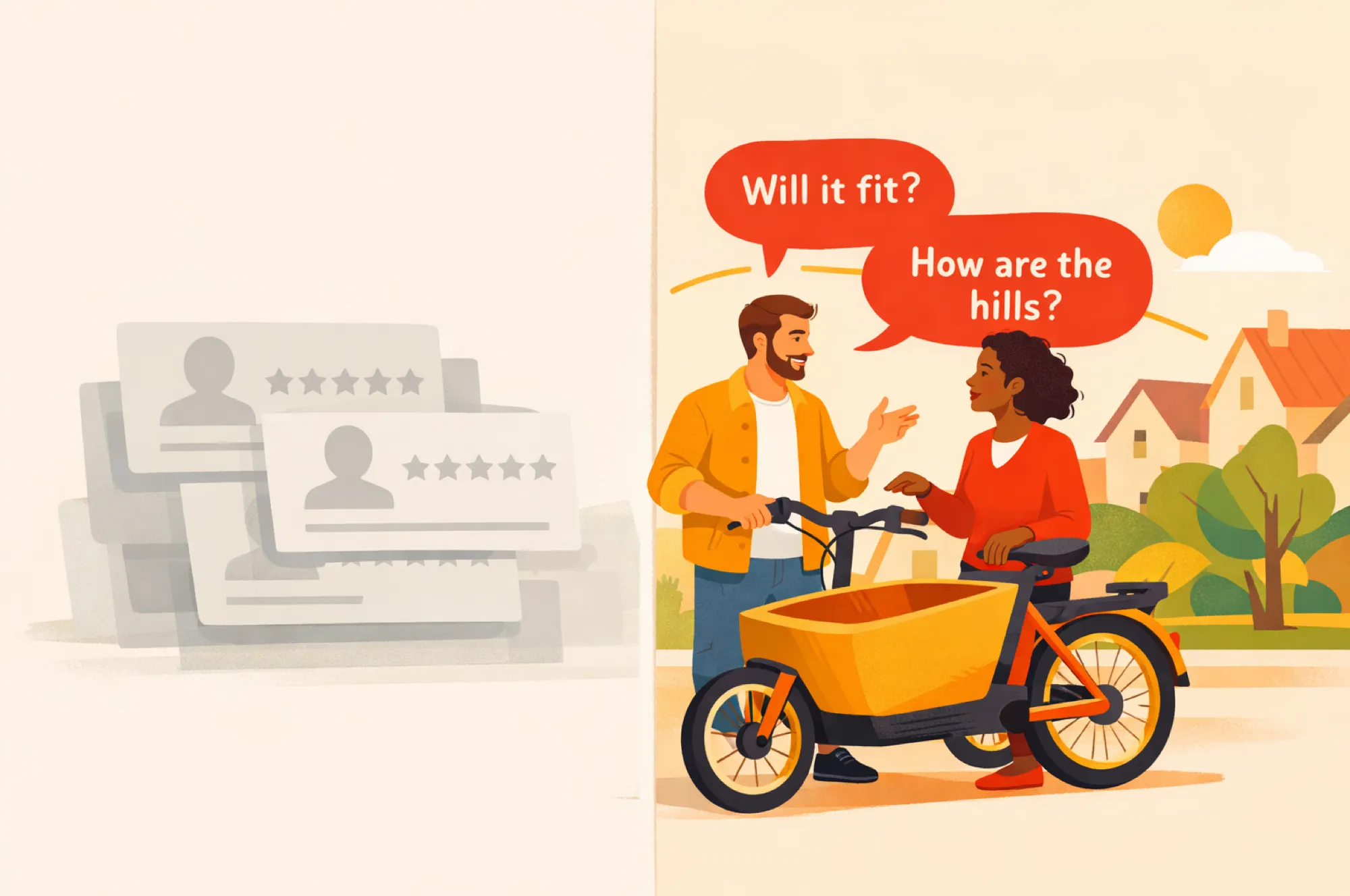
When someone is considering a $5,000 cargo bike, a $3,000 electric scooter, or a $15,000 tiny house kit, the questions they have aren’t answerable by a star rating. They’re questions like:
- “Will this actually fit in my garage with two cars?”
- “How does it handle hills? I live in Southeast Ohio, not Kansas.”
- “My kids are 2 and 5. Will they outgrow this in a year?”
- “What’s the battery really like after 18 months?”
- “I’m 6’3”. Is it comfortable for me?”
These are specific, personal, contextual questions. Reviews are a monologue. They can’t answer follow-ups or ask clarifying questions. They’re a one-time snapshot from someone whose situation may be nothing like yours.
I talked about this on a recent episode of the Scaling Smart podcast. The host, Brad Morrison, immediately got it. Reviews level the playing field for new brands, but they can’t replace the depth of a real conversation. That depth is exactly what high-ticket buyers need.
What High-Ticket Prospects Actually Need
After talking to dozens of DTC brand founders and hundreds of their customers, one pattern is clear. By the time someone is seriously considering a $3,000+ purchase, they’re past the awareness stage. They’ve seen the ads, read the reviews, and watched the YouTube unboxing videos.
What they’re doing now is comparing. Brand X vs. Brand Y vs. Brand Z. They’re deep in the middle and bottom of the funnel. No amount of marketing content gives them what they actually need: a dialogue.
Not a testimonial. Not a case study. Not a polished brand video. A conversation, with someone who has no financial incentive to say nice things, who owns the product, and who can answer the specific question keeping them up at night.
As I put it on the show: influencers and ambassadors matter, but they’re typically top-of-funnel. When someone is choosing between three cargo bikes and needs to know if it handles hills with two kids and groceries, that’s not an influencer’s job. That’s a conversation between two parents.
The Neighborhood Showroom Insight
I want to tell you a story that fundamentally shaped how I think about advocacy.
There’s an outdoor furniture company called Outer that’s been around for a little over ten years. They make premium outdoor furniture, the kind where you can leave the cushions outside year-round. When they launched, the founder had a simple frustration: shopping for outdoor furniture in a showroom at Lowe’s tells you almost nothing about how it holds up after three months of rain and snow.
So they created something called the Neighborhood Showroom Program. Real customers would let prospective buyers visit their backyard to see the furniture in its natural habitat. Weather-beaten, lived-in, real.
The trajectory is what gets interesting. When they started, they seeded the program: paid people well, promoted it actively. But today? Over 1,000 neighborhood showrooms. And they give zero incentive. They don’t even promote the program anymore. People just sign up because they love the product and want to share it.
When I talked to the founder, what struck me wasn’t the scale. It was the motivation. These aren’t people chasing a referral code. They’re people who genuinely enjoy showing off something they love. They’re the extroverted neighbor who says, “Come sit on my deck, let me tell you about it.”
And here’s the kicker: two people met through a neighborhood showroom visit and ended up getting married. I always add the disclaimer (results not guaranteed), but it perfectly captures something important. When you create space for real human connection around a product, you get outcomes that no affiliate link will ever produce.
Why Advocates Say Yes (Money Isn’t the Reason)
This is the question I get most from brand founders: “Will my customers actually do this?”
The concern makes sense. You’re asking real people to give up their time, maybe even let strangers into their home or meet them in a park. Why would anyone say yes?
The answer surprised me at first, but after seeing it play out across multiple brands, it’s now one of my strongest convictions: money has almost nothing to do with it.
Sure, brands handle incentives differently. Some offer points. Some offer cash when a sale happens. But the money isn’t life-changing, and it doesn’t need to be. The advocates who sign up and stay engaged are there for three reasons:
1. They genuinely love the product. Not in a “this is fine” way. In a “let me tell you about this thing” way. If you’ve ever had a friend corner you at a party to talk about their new e-bike, you’ve met this person.
2. They’re social. The best advocates tend to be more extroverted, community-minded people. Being an advocate gives them a reason to meet new people, share something they’re passionate about, and feel like part of something bigger than a transaction.
3. They want to help. There’s a genuine desire to help someone else make a good decision. They remember what it was like to be on the fence, and they want to pay forward the confidence someone else gave them.
One brand founder pushed back on me: “Are customers really willing to let people come to their house? That seems like a strange thing.” And I get that reaction. But Outer has 1,000+ people doing exactly that, with zero incentive. For the right product, with the right kind of customer, advocacy is something people want to do.
The key insight: you don’t need thousands of advocates. You need 25 to 50 passionate customers. Most brands already have hundreds of people who would say yes. They just haven’t asked yet.
From Fragmented to Unified
One problem I keep hearing from marketing leaders at DTC brands: the tools are fragmented and so is the strategy.
There’s one platform for influencer management. Another for affiliate links. A third for ambassador programs. Maybe a review tool on top of that. Each one has its own dashboard, its own reporting, its own way of tracking ROI. And none of them talk to each other.
I brought this up on the podcast because this is a strategic problem, not just a technology one. When your people-powered marketing is spread across four tools and three different team members’ pet projects, nothing gets the attention it deserves.
In practice, this is what happens: a CMO or marketing lead builds out an ambassador program, gets it running, and then leaves. CMO turnover at DTC brands is real. It’s an industry-wide pattern. The next person comes in and doesn’t want to touch the previous person’s project. The program withers. The advocates who signed up feel forgotten. The brand loses everything it built.
What marketing leaders actually want is one place: one system that handles the community map, the conversations, the rewards, and the reporting. Not three point solutions duct-taped together.
That’s a big part of why we built Stoked the way we did: one platform that brings advocates, conversations, and measurement together in a single system.
What This Means for Your Brand
If you’re a DTC founder selling a high-consideration product, something over $1,000, something that changes a lifestyle, something where buyers have real questions reviews can’t answer, consider this:
1. Audit your trust stack. Look at your product page through the eyes of someone about to spend $5,000. How many of their specific, personal questions can your reviews and testimonials actually answer? If the answer is “not many,” you have a trust gap.
2. Identify your natural advocates. You don’t need to recruit. Look at who’s already tagging you on social media, emailing your support team with love letters, or telling their friends at the playground. These people exist. You just need a system to activate them.
3. Start with 25. You don’t need a thousand advocates. You need 25 passionate customers who are willing to answer questions and maybe meet up with a prospect in their area. A CSV upload and a weekend of outreach is all it takes to get started.
4. Measure conversations, not just conversions. Track how many prospects connect with advocates, how many conversations happen, and what those conversations lead to. Bunch Bikes found that 40% of their sales were driven by advocates, but they could only see that because they had the system in place to track it.
5. Reward authentically. Points, cash, experiences, whatever fits your brand. But remember that the best advocates aren’t in it for the money. They’re in it because they love your product and your community. Celebrate them. Make them feel valued. That matters more than the dollar amount.
The Trust Gap Isn’t Closing: It’s Widening
If anything, the problem is getting worse. AI can generate a thousand “verified reviews” before breakfast. Consumers know it. A recent Gartner study projects that AI-generated content will erode brand trust significantly by 2028. The brands that win won’t be the ones with the most reviews. They’ll be the ones who can prove their customers are real people having real experiences.
This is a humanity problem, not a technology one. The solution isn’t more content. It’s more connection.
A five-star rating tells you a product is generally liked. A real conversation tells you whether it fits your life. For high-ticket DTC, the difference between those two things is the difference between a bounced visitor and a customer for life.
Related Reading
- Switching To Stoked, Seeing Results: Bunch Bikes Case Study. How Bunch Bikes drove 40% of sales through advocates
- The Great Review Con Game. Why trust in reviews is dying and what to do about it
- From ROAS Doom Loop to Durable Growth. Moving beyond performance marketing to brand-led advocacy
- Ricky Chilcott on Scaling Smart. The full podcast recap with timestamps