Measuring Advocacy Impact: Five Metrics That Actually Matter for DTC Brands

You wouldn’t measure a restaurant’s success by how long people stare at the menu.
So why are advocacy platforms still telling brands to track “widget impressions” and “time spent in plugin”?
Here’s the uncomfortable truth: most advocacy measurement frameworks are built around vanity metrics. They count eyeballs instead of outcomes. They report “engagement” without connecting it to a single dollar of revenue. And they leave premium DTC brands guessing about the one question that actually matters: Is this working?
We’ve talked before about why vanity metrics are the enemy of real advocacy ROI. Now let’s get specific. If you’re evaluating an advocacy platform — or trying to prove the value of one you’re already running — these are the five categories of metrics that separate signal from noise.
But first — before we talk about what to measure — we need to talk about why it’s worth measuring at all.
The Foundation: Seeing Is Believing, and Trying Means Buying
Some products sell themselves on specs. A laptop, a phone case, a pair of running shoes — you can compare them on a spreadsheet, read a few reviews, and click “buy” with reasonable confidence.
Then there are products where the first reaction isn’t “is this good?” — it’s “wait, that’s a thing?”
Cargo bikes. Electric scooters. Tiny houses. Premium outdoor furniture you leave outside year-round. These aren’t just high-ticket purchases. They’re category-creation purchases. The prospect isn’t comparing your product to a competitor. They’re trying to wrap their head around whether this entire category belongs in their life.
Bunch Bikes hears it all the time: “What IS that thing?” The sales funnel doesn’t start at awareness — it starts at belief. And no amount of ad spend, star ratings, or influencer content can make someone believe a product will work for them the way a conversation with another human can.
When a parent in Portland texts with a parent in Denver who loads three kids into their cargo bike every morning — that’s not a “touchpoint.” That’s a worldview shift. The prospect goes from “I don’t know anyone who owns one” to “I just talked to someone like me who can’t imagine life without it.”
This is what makes advocacy fundamentally different from every other channel. It’s not a more authentic version of a review. It’s not a cheaper version of an influencer. It’s the only channel where a real person, unpaid and unscripted, can answer the question no marketing asset ever will: “Does this actually work in a life like mine?”
And for novel, high-consideration products, that human-to-human moment is where the sale actually happens. Everything after — the offer page, the checkout, the attribution — is just the paperwork. The decision was made in the conversation.
That’s what the five metrics below exist to capture and amplify. Not because the conversation itself needs to be quantified — but because the system that creates those conversations needs to be measured, tuned, and scaled.
1. Authentic Social Proof: The Trust Signal Prospects Evaluate Before They Ever Reach Out
Every advocacy program starts with a simple premise: real customers, visible and accessible, build trust that no star rating can match.
But “how many advocates do you have?” is the wrong question. A map with 500 pins and no activity is wallpaper. A map with 40 responsive, engaged advocates in the right locations is a conversion engine.
What to measure:
- Active advocate count — Not total enrolled. How many advocates have participated in a conversation in the last 90 days? This is your real capacity.
- Geographic coverage — Are your advocates where your prospects are? If you sell nationally but your advocates cluster in two ZIP codes, you have a visibility problem.
- Advocate-to-prospect ratio — How many incoming prospects can your current advocate base realistically serve? If you’re generating more interest than your advocates can handle, you’ll see response times spike and completion rates drop.
Why this matters for high-ticket DTC:
When someone is deciding whether to spend $3,000 on a cargo bike, they don’t just read reviews — they look for someone like them. A parent in their neighborhood. An owner who rides the same terrain. The map isn’t a feature; it’s the first trust checkpoint in the buyer’s journey.
A well-distributed, active advocate community tells the prospect: People like me bought this, loved it, and are willing to talk about it. That’s social proof you can’t manufacture with star ratings or paid influencers.
2. Engagement Quality: Conversations, Not Clicks
This is where most measurement frameworks fall apart. They count impressions — how many people saw the widget — and call it engagement. That’s like counting how many people walked past your store. It tells you nothing about whether they came in, tried something on, or talked to anyone.
Real engagement in an advocacy program is a conversation. A prospect found an advocate, reached out, and started a dialogue. That’s the metric.
What to measure:
- Map impressions — Yes, this is top-of-funnel and directional. It tells you how many prospects are seeing your advocate community. But treat it as a leading indicator, not a success metric.
- Conversations started — The core engagement metric. For most DTC brands running an active program, 5–20 new conversations per month is a healthy range. If you’re below that, your map placement or advocate density may need attention. If you’re above it, you’re building a real channel.
- Offer page views — When an advocate shares a personalized offer with a prospect, and the prospect clicks through to view it, that’s one of the highest-intent signals in the entire funnel. This person has already had a real conversation with a real owner and is now looking at a specific path to purchase. This isn’t a “widget impression” — it’s a buying signal.
- Response rate and time to first reply — How quickly do advocates respond? Prospects reaching out to a real person expect a real response. If the median time to first reply stretches past 24 hours, you’re losing the momentum that drove them to reach out in the first place.
The quality reframe:
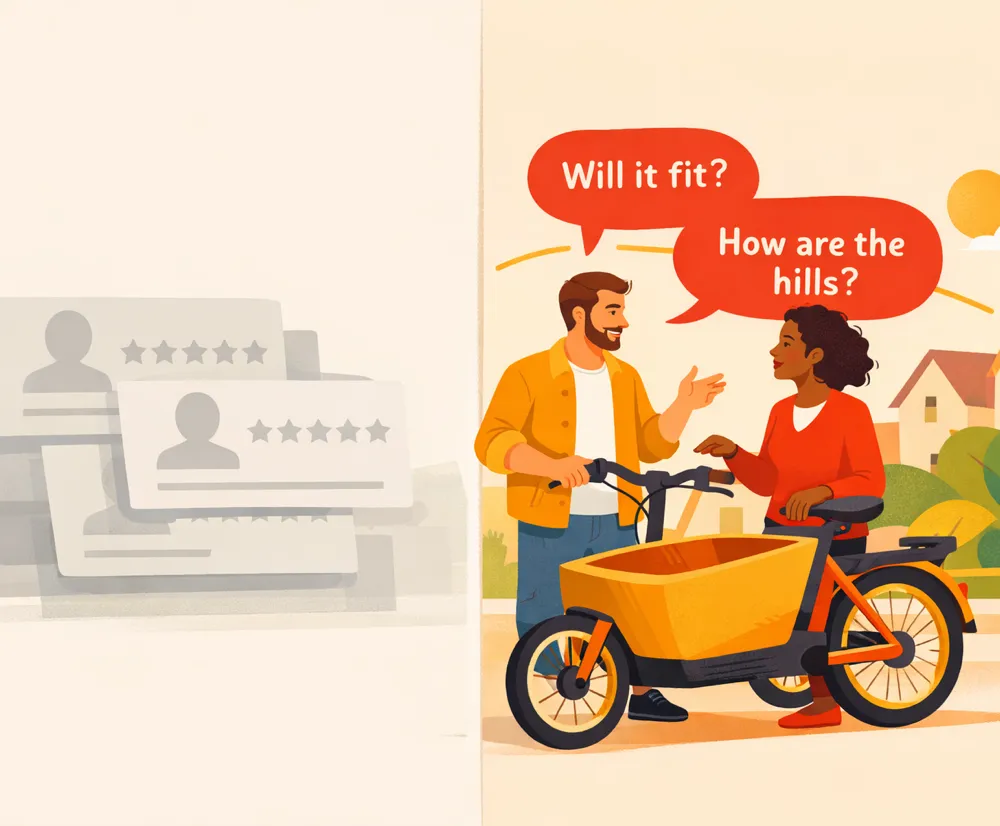
One real SMS conversation between a prospect and an advocate who owns the product — where the prospect asks “How does it handle hills with two kids?” and gets a photo of the advocate’s actual commute — is worth more than 10,000 widget views. Bunch Bikes found this out firsthand: after switching to a platform that prioritized real conversations over vanity reach, 40% of their sales were directly driven by advocates.
3. Conversion Attribution: From Conversation to Revenue
This is the metric that justifies the entire program. And it’s the one most platforms handle poorly — either ignoring it entirely or reducing it to a “cross-reference this email list with your sales data” exercise.
Attribution in advocacy is genuinely hard. The prospect who talked to an advocate on Tuesday might not buy until the following week. They might click a retargeting ad first. They might navigate directly to your site. Traditional last-click attribution will give credit to the ad — not the conversation that actually built the confidence to buy.
What to measure:
- Offer click-throughs — When a prospect moves from a conversation to viewing a personalized offer page to clicking “Shop Now,” you have a direct, traceable chain from advocacy to purchase intent. This isn’t inferred; it’s observed.
- Advocacy-attributed revenue — We’ve written extensively about the Advocacy ROI formula: Revenue Attributed to Advocates minus Total Program Cost, divided by Total Program Cost. A target of 3:1 or higher is strong — and well-run programs regularly exceed it.
- Average Order Value (AOV) of advocate-touched sales — Do prospects who talk to an advocate spend more? In most cases, yes. They’re buying with confidence, not hedging. They’re less likely to choose the cheapest option and more likely to add accessories or upgrades.
- Attribution window — Consider your product’s typical decision timeline. A $50 purchase might close in 3 days. A $5,000 cargo bike might take 30 days or more. Your attribution window should match your sales cycle, not an arbitrary default.
The “last conversation” argument:
Here’s our stance, and we’ll be direct about it: the last meaningful conversation matters more than the last click. When a prospect spends 20 minutes talking to someone who owns the product, asking their specific questions, seeing real photos — that conversation is the moment the purchase decision crystallized. Whether they click an ad a week later or type the URL directly is a formality.
By attributing the sale to the advocate, you’re acknowledging the actual decision point — not just the final digital breadcrumb. This is how Bunch Bikes calculated that 40% of sales were advocate-driven, up from 16% before switching platforms. The conversations were always happening; the attribution just finally caught up.
4. Product Intelligence: What Your Prospects Are Actually Asking
Here’s a pillar that most advocacy measurement frameworks ignore entirely — and it might be the most strategically valuable one.
Every conversation between a prospect and an advocate is a window into your buyer’s mind. Not what they tell you in a survey (where they perform). Not what they click on your website (where they browse passively). What they actually ask when they’re talking to a peer with no brand presence in the room.
What to measure:
- Topic frequency — What questions come up most? “How does it handle hills?” “What’s the battery like after a year?” “Will my kids outgrow it?” AI-powered conversation summaries surface these patterns automatically, across hundreds of conversations, without anyone reading transcripts.
- Sentiment analysis — Are conversations trending positive, neutral, or negative? A sudden shift in sentiment can flag a product issue, a competitor move, or a messaging gap before it shows up in your support queue.
- Objection patterns — What’s stopping people from buying? If “I’m worried about assembly” appears in 30% of conversations, that’s not just a support issue — it’s a landing page problem, a content gap, and a product opportunity rolled into one.
- Use-case discovery — Prospects reveal use cases your marketing team never imagined. A cargo bike company might learn that 15% of conversations are about using the bike for small business deliveries — an entire segment to target that came straight from peer conversations.
Why this is strategic gold:
Your marketing team gets messaging insights. Your product team gets feature priorities. Your support team gets a preview of incoming tickets. And all of it comes from the most authentic source possible: unscripted conversations between real people.
No review platform gives you this. Reviews are a monologue — one person’s snapshot, posted once, with no follow-up questions possible. Advocacy conversations are a dialogue, and the patterns inside them are a real-time focus group you didn’t have to organize.
5. Community Health: The Leading Indicators That Predict Everything Else
The four pillars above measure outputs — what your advocacy program is producing right now. This fifth pillar measures the inputs — the health of the engine itself. Ignore these, and the outputs will quietly degrade.
Think of it like this: conversion attribution tells you how many sales your advocates drove last month. Community health tells you whether they’ll still be driving sales six months from now.
What to measure:
- Advocate retention rate — What percentage of advocates who were active 6 months ago are still active today? Advocacy is a compounding strategy, not a campaign. If you’re churning through advocates, you’re rebuilding instead of compounding.
- Conversation completion rate — What percentage of started conversations reach a natural conclusion (vs. going cold)? If prospects are reaching out but conversations are dying, something is broken — response time, advocate engagement, or the matching itself. Bunch Bikes saw this metric at a painful 60%+ failure rate before switching platforms. After? Approximately 90% of conversations are self-serve and successful.
- Advocate satisfaction signals — Are advocates requesting rewards? Providing feedback? Responding promptly? These are leading indicators of engagement. An advocate who stops responding isn’t just one lost connection — it’s a prospect who gets ghosted and a brand that looks unresponsive.
- New advocate enrollment rate — Is your advocate base growing organically? The healthiest programs see customers asking to become advocates — not just responding to recruitment emails. That’s a signal that your community has real momentum.
Why leading indicators matter:
Most brands only notice a community health problem when conversions drop. By then, the damage is done — advocates have disengaged, prospects have been ghosted, and rebuilding trust takes months. Monitoring these inputs gives you a 60-90 day early warning system.
The Reduced Returns Dividend
One outcome worth highlighting cuts across all five pillars: well-informed buyers return less.
When a prospect has a real conversation with a real owner — asks their specific questions, sees the product in a real-world context, gets honest answers about limitations — they buy with calibrated expectations. No surprises. No “this isn’t what I thought it would be.”
For brands selling $1,000+ products where a return means shipping logistics, restocking costs, and a damaged customer relationship, this isn’t a nice-to-have metric. It’s a financial lever that compounds alongside every other measurement in this framework.
You don’t measure reduced returns directly through your advocacy platform. You measure it by comparing return rates for advocate-touched sales vs. non-advocate sales over time. The gap will tell you exactly how much those conversations are worth beyond the initial conversion.
Stop Measuring Activity. Start Measuring Impact.
The difference between a vanity dashboard and a real measurement framework is the difference between knowing something happened and knowing what it’s worth.
Widget impressions tell you people saw something. Conversations started tell you trust was initiated. Offer click-throughs tell you purchase intent was created. Advocacy-attributed revenue tells you the program is paying for itself — and then some.
If you’re evaluating advocacy platforms, ask this: Can you show me the path from conversation to revenue? If the answer involves exporting CSVs, cross-referencing email lists, and hoping your CRM connects the dots — that’s not measurement. That’s guesswork with extra steps.
The brands that win in high-ticket DTC aren’t the ones with the most reviews or the biggest ad budget. They’re the ones who put real people in the loop and can prove it’s working.
Related Reading
- The Brand Advocacy Ratio — The ROI formula for measuring advocacy’s financial power
- Switching to Stoked, Seeing Results: Bunch Bikes Case Study — 40% of sales driven by advocates
- Why Real Conversations Beat Reviews for High-Ticket DTC — The trust gap star ratings can’t close
- The Great Review Con Game — Why trust in reviews is eroding
- Rethinking Advocacy: From Accidental Testimonials to Sustainable Growth — Building structured programs that compound