When Your Advocacy Platform Disappears: What Smart Brands Do Next

It’s Monday morning. You open your advocacy dashboard to check weekend conversations. The page doesn’t load. You refresh. Nothing. You try a different browser. Still nothing. You check the vendor’s status page—it’s gone too. Their Twitter hasn’t posted in weeks. Their support email bounces.
Your advocate community page—the one embedded on your product pages, the one that’s been driving conversations between prospects and real customers—shows a 404.
This isn’t hypothetical. It’s happening right now across the brand advocacy space. Platforms going dark. Communities vanishing overnight. Brands left scrambling to figure out where their advocate data went and how to keep the conversations going.
Here’s the thing: the market for brand advocacy is growing. The brand advocacy software market is projected to grow from ~$440M in 2025 to nearly $1B by 2032, at a 12%+ CAGR. The category is right. Consumer demand for authentic peer-to-peer conversations is accelerating—especially as AI-generated content makes every other form of social proof suspect.
So why are platforms disappearing?
Because the category being right and a specific vendor surviving are two very different things. Your strategy was correct. The challenge was finding a platform built to last.
If you’re dealing with this right now—or you’re worried you might be soon—this post is for you. We’ll cover why it keeps happening, what you actually lose, how to triage the immediate crisis, and how to pick a platform that will genuinely be here next year.
Why Advocacy Platforms Keep Disappearing
The pattern is depressingly consistent. And it’s not just small startups—this has played out across the entire spectrum of the industry over the past five years.
Influitive, the most prominent B2B customer advocacy platform, was acquired by private equity in late 2023—followed by mass layoffs, gutted support, and steep price hikes. Forrester literally published a blog post titled “What To Do Next About Your Customer Advocacy Platform” in response. CrewFire, a brand ambassador platform, was acquired and shut down in May 2023. Dynamic Signal, which raised $70M+ for employee advocacy, merged and rebranded into something else entirely. Smync, a pure-play brand advocacy platform, simply closed. Experify, a Zurich-based peer-to-peer review platform that raised $4M in seed funding, was acquired in late 2024 and is shutting down March 27, 2026 — recommending Stoked as a trusted partner for their brands. (If you’re an Experify customer, see our migration guide.) Even LinkedIn tried advocacy twice—LinkedIn Elevate in 2020, then their My Company advocacy tab in 2024—and abandoned it both times.
A promising advocacy platform launches, raises a seed round, builds early traction with a handful of brands—and then quietly fades away 18-36 months later. Here’s why:
The VC treadmill turns a seed round into a countdown timer. A $2M seed round doesn’t mean stability. It means the company has 18-24 months to hit growth metrics that justify a Series A. If they don’t? The money runs out and the product goes dark. That seed round wasn’t a foundation—it was a fuse.
Feature creep into adjacent markets. Advocacy is a specific, focused problem. But investors want TAM stories, so founders get pulled into referral programs, loyalty points, general community platforms, influencer management—anything to make the addressable market look bigger on a slide deck. The product gets bloated, the team loses focus, and the original advocacy use case gets neglected.
Good idea, bad timing. Some of the earliest movers in peer-to-peer advocacy were genuinely ahead of the curve. They built the right thing before enough brands understood why they needed it. By the time the market caught up—especially as AI created real urgency around authentic conversations—those early movers had already burned through their runway and shut down.
International complexity kills quietly. SMS-based advocacy that works beautifully in the US hits a wall when brands sell globally. Regulatory differences, carrier agreements, cost structures—the operational complexity of truly international support is enormous. Many platforms promise it and can’t deliver. (I can say this from first-hand experience—we’re working through international expansion at Stoked right now, and it’s genuinely hard. The brands that need it deserve honesty about the complexity, not hand-waving.)
The result? A graveyard of advocacy platforms that validated the category but couldn’t survive as businesses. And brands that believed in the approach are left holding the bag.
This is the deeper version of the ROAS doom loop—not just overspending on ads, but overspending on infrastructure that vanishes. For more on breaking free from performance marketing dependency, see From ROAS Doom Loop to Durable Growth.
What You Actually Lose
Let’s be honest about what happens when your advocacy platform goes dark. It’s worse than most people think—not because the relationships are gone, but because the infrastructure that made those relationships productive disappears.
Your advocate relationships are intact but invisible. Your happiest customers still love your product. They’d still happily talk to prospects. But without a platform routing conversations, tracking engagement, and managing rewards, those advocates become invisible to the prospects who need them most.
Your prospect pipeline breaks immediately. That interactive map on your product pages? The one where high-intent buyers browse real owners near them and start conversations? It’s gone. Those prospects—the ones already on your site, already considering a purchase, already looking for that final push of confidence—have nowhere to go. They bounce. Some buy from a competitor. Some just don’t buy at all.
Your data disappears. Conversation histories. Advocate activity metrics. Reward balances you promised to honor. ROI attribution that justified the program’s budget internally. All of it—gone. Try explaining to your CEO that the program “was working great” when you can’t produce a single report.
Your team’s time explodes. Before Stoked, the team at Bunch Bikes was spending 90 minutes a day manually managing advocate conversations. That’s the reality of running advocacy without proper tooling—or with tooling that just disappeared. Every email, every text, every follow-up, every reward calculation—all done by hand.
If you’re feeling the sting of this right now, I get it. You did the hard thing. You built an advocacy program. You convinced your team, recruited advocates, integrated the platform into your site. You were right about the strategy. You just got unlucky on the vendor.
So let’s fix it.
The 72-Hour Triage Plan
If your platform just went dark—or you have strong signals it’s about to—here’s what to do right now. Speed matters because every day without a functioning advocacy channel is a day your highest-intent prospects can’t connect with real customers.
1. Export everything you can, immediately
If the platform is still partially accessible, pull every CSV, spreadsheet, and report you can find. Advocate lists with contact info. Conversation logs. Reward balances. Analytics exports. Even if the data is messy, get it out. You can clean it up later. You can’t recover it after the servers go offline. Take screenshots of dashboards, reports, and settings—even a screenshot is better than nothing when the servers go dark.
Reach out to the company directly, too. Even if the product is winding down, the team may still be able to provide a data export. Most founders want to do right by their customers on the way out—but they won’t offer if you don’t ask.
If the platform is already completely dark, check your email for any automated reports or exports you received historically. Check your CRM for synced data. Check your team’s inboxes for onboarding emails that might contain advocate details.
2. Communicate with your advocates directly
Do not rely on the dead or dying platform to relay messages. Send a direct email to your advocates—from your own domain, your own email system—explaining the situation. Be transparent: the platform is transitioning, you’re moving to a new home, their participation matters, and you’ll honor any outstanding rewards.
Your advocates volunteered their time because they love your product, not because they loved the software. That loyalty transfers—but only if you communicate.
3. Put a temporary bridge in place
Even a simple “Talk to an Owner” form on your product pages is better than nothing. A Google Form. A Typeform. A mailto link. It’s ugly, it’s manual, but it works. The goal isn’t elegance—it’s keeping the prospect-to-advocate connection alive while you migrate properly.
4. Evaluate your options
Don’t panic-buy the first alternative you find, but don’t overthink it either. Look for platforms that have migration support—import tools for competitor data exports, CSV importers for custom spreadsheets—and a team willing to help you through the transition.
5. Move fast and confidently
The window between “our platform died” and “our advocates disengage” is shorter than you think. Most advocate communities maintain momentum for 2-4 weeks after a disruption. After that, re-engagement gets significantly harder. You already know what you need—you’ve been running an advocacy program. Trust that experience and move.
How to Pick a Platform That Will Actually Be Here Next Year
This is the part where I have an obvious bias, so let me be direct about it: I’m the founder of Stoked. I’m going to describe the evaluation criteria we think matter most—and yes, Stoked checks these boxes. But these criteria are genuinely useful regardless of who you choose. Use them.
Business model sustainability
Ask the hard question: is this company built to last? There’s nothing inherently wrong with venture funding—plenty of great companies are venture-backed. But it’s worth understanding the incentives. A company that sustains itself on customer revenue has a simple alignment: serve customers well, stay in business. A company on a fundraising treadmill has a more complex set of pressures—growth metrics, board expectations, potential pivots. At Stoked, we’re currently bootstrapped and profitable on customer revenue. That might change someday, but the commitment to building for the long term won’t. Ask any vendor you’re evaluating: what does sustainability look like for you in five years?
Transparent pricing
Published pricing tiers on the website. Not “contact us for a quote.” Not “custom pricing for every customer.” If a company can’t tell you what it costs without a sales call, that’s a signal—either the pricing isn’t standardized (chaotic) or it’s designed to extract maximum revenue per deal (misaligned incentives).
Migration support—and data portability
This is the one most brands overlook until it’s too late. Does the platform have actual importers for competitor exports? Can it ingest custom CSV formats for advocate data, conversation history, and reward balances? Is migration assistance included in the plan, or is it a five-figure professional services engagement?
And just as important: can you get your data out if you ever want to leave? At Stoked, we’ve believed since day one that you should be able to download all of your data at any time. We compete on product, not by holding your data hostage. Migration support is included in Pro and Enterprise tiers—both coming in and going out.
Product focus
Is the company laser-focused on peer-to-peer advocacy, or is it trying to be a referral platform, a loyalty program, a community hub, an influencer marketplace, and a review aggregator all at once? Focus matters. The companies that disappear are almost always the ones that spread too thin trying to be everything.
Active development and transparency
Is the product actively shipping features? Is there a public blog, changelog, or product update cadence? Can you see recent activity, or does the last blog post date from 18 months ago? Active development is a survival signal.
Customer references—especially migrators
Ask for a customer who migrated from another platform. If the vendor can provide that reference, you learn two things: they’ve done this before, and at least one real customer trusts them enough to vouch for the experience.
Here’s ours: Bunch Bikes migrated to Stoked about a year ago. Since then, 40% of their sales have been driven by advocate conversations. Admin time dropped from 90 minutes per day to 20 minutes. Their founder Aaron and Director of Community Lelac are happy to talk to any brand considering the move—ask us for an intro.
Why This Moment Is Different — AI Makes Real Conversations More Valuable
Here’s the strategic angle most brands are missing while they scramble to replace a dead platform: the value of authentic peer-to-peer conversations is increasing, not decreasing.
AI can now generate fake reviews at scale. Convincing ones. With varied writing styles, specific product details, and realistic rating distributions. Consumers are catching on. A 2025 survey found that nearly half of consumers now actively distrust online reviews. That number is only going up.
AI can write glowing testimonial copy. It can generate social proof that looks real. It can populate a product page with “customer stories” that never happened.
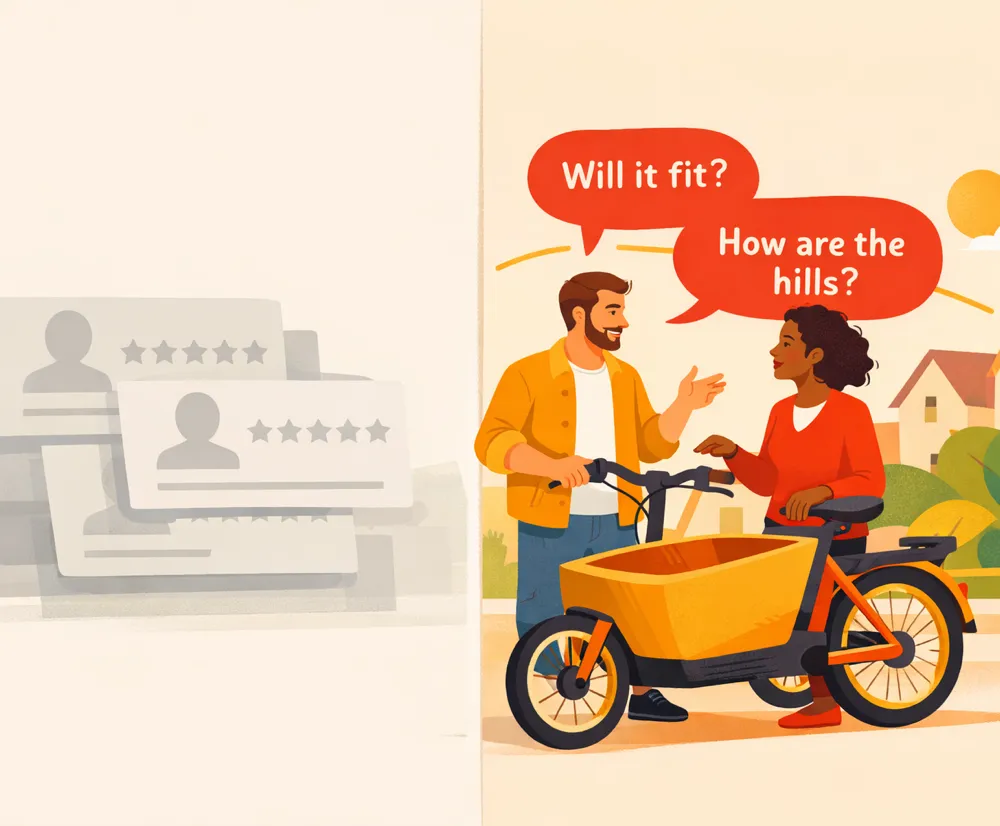
But here’s where AI hits a wall: a live, multi-turn SMS conversation between a prospect and a real product owner. Can AI technically hold a conversation? Sure. But when a prospect asks to meet at the park to see the bike in person and a robot shows up—the jig is up. When a prospect texts an advocate and asks “How does it handle hills near your house?” and gets a response with a photo of the actual hill—that’s real. When the conversation spans three days and includes follow-up questions about garage dimensions and winter storage—that’s authenticity that matters precisely because it’s human.
The entire social proof landscape is shifting. Star ratings, written reviews, testimonial quotes, influencer endorsements—all of it is becoming suspect as AI makes generation trivially cheap. The one form of social proof that’s inherently AI-resistant is a real-time, private, multi-turn conversation between two real humans.
That’s what advocacy platforms provide. And that’s why the category is growing even as individual vendors struggle to survive.
For a deeper dive on the erosion of review trust and what replaces it, read The Great Review Con Game.
New Faces, Same Mission
We’re excited to welcome Cruzbike to the Stoked community. They’re migrating from Experify and launching on Stoked mid-March 2026—we’ll have more to share about their results soon.
Every brand that migrates to Stoked brings something invaluable: a community that’s already doing the hard work. Their advocates already believe in the product. Their customers are already having conversations. What they need isn’t a fresh start—it’s a better home. More reliable infrastructure. Smarter tools. A platform that will be here tomorrow.
The need is real and growing. High-consideration product buyers—people spending $1,000, $3,000, $5,000 on a purchase—need more than a star rating and a paragraph of text. They need to talk to someone who actually owns the thing. They need specific, personal, contextual answers that only a real owner can provide.
That’s what advocacy does. That’s what Stoked enables. And that’s what these communities deserve—a platform that takes the mission as seriously as they do.
The Platform Is the Infrastructure. The Community Is the Asset.
Here’s the thing to remember if your advocacy platform just disappeared: your community didn’t.
Your advocates are still out there. They still love your product. They’re still willing to talk to prospects, share their experiences, answer the specific questions that close sales. No platform shutdown changes that.
What disappeared was the infrastructure—the routing, the tracking, the rewards, the embeddable widgets, the analytics. That’s replaceable. Your community isn’t.
The brands that thrive through this kind of disruption are the ones that act quickly, communicate transparently with their advocates, and choose their next platform based on sustainability—not just features. Built for the long term. Focused over feature-bloated. Transparent over opaque.
At Stoked, we’re bootstrapped. Our pricing is on the website. We ship product updates every month. We’re obsessively focused on one thing: making peer-to-peer brand advocacy work for premium DTC brands. We’ve been listening to our customers, and we plan to keep building it for many years to come.
If your platform disappeared—or if you’re watching the warning signs and getting nervous—you’re not starting over. You’re upgrading. Your advocates did the hard part. Let’s give them the home they deserve.
Building an advocacy program from scratch? Start with From Quiet to Choir: How Smart Brands Turn Their Happiest Customers Into Their Loudest Advocates.