How to Market a Cargo Bike Brand
Selling a cargo bike is not selling a bike.
You’re asking someone to spend $2,000 to $8,000 on a vehicle that will replace car trips, haul their kids to school, and live in a garage they may not even have. It’s a lifestyle decision dressed up as a purchase. And it’s terrifying for the buyer.
That fear is the whole game. Cargo bike marketing is less about features and more about removing doubt, one specific, personal worry at a time. The brands that win are the ones that make a nervous shopper feel like they already know someone who took the leap and loved it.
This is the playbook: positioning, channels, content, your existing riders, the returns problem nobody talks about, and the mistakes that quietly bleed your budget.
This is the cargo-specific version. For the wider category, see our guide to marketing an e-bike brand and the tools worth knowing.
Start with positioning, not promotion
Most cargo bike brands describe themselves the same way: range, payload, motor wattage, battery specs. That’s a spec sheet, not a position.
The buyer isn’t shopping for watts. They’re shopping for an answer to a question they’re afraid to say out loud: “Will this actually work for my life?”
Your positioning has to answer the real job the bike does. Three jobs dominate this category:
- The car replacement. Families ditching a second car, running errands, doing school runs. They care about safety, kid capacity, weather, and whether they’ll actually use it past month two.
- The hauler. Tradespeople, delivery riders, small businesses moving gear. They care about payload, durability, and downtime.
- The adventure/utility blend. People who want to carry a dog, a surfboard, a week of groceries, and still have fun. They care about versatility and not looking like a minivan.
Pick the rider you serve best and build everything around them. A brand that tries to be the cargo bike for everyone is the cargo bike for no one. Bunch Bikes didn’t win by being the cheapest or the lightest. They won by owning the front-loader family bike conversation so completely that “Bunch” became shorthand for “the bike that hauls my kids.”
Your positioning should make the right buyer feel seen in the first five seconds and gently tell the wrong buyer this isn’t for them. That’s not losing a sale. That’s preventing a return.
Choose channels that match a long, considered purchase
A $4,000 bike is not an impulse buy. The sales cycle runs weeks to months, and the buyer touches you five, ten, fifteen times before they commit. Your channel mix has to support a slow burn, not a single click.
Paid acquisition (use it, don’t lean on it)
Paid social and search work early in the buying process, getting on the radar of someone Googling “best electric cargo bike for kids.” But cargo bike margins and rising ad costs make paid-only growth brutal. Acquisition costs keep climbing. Conversion stays stubborn. No amount of retargeting closes a fear-based decision.
Treat paid as a way to start the conversation, not finish it. If you’re feeling the squeeze of climbing acquisition costs, we wrote about structurally lowering your CAC by leaning on customers instead of ad spend.
Local and experiential
Cargo bikes are geographic. People want to ride one before they buy. Test rides, demo days, local bike co-ops, and farmers-market pop-ups convert better than almost any digital touch. They erase the “I can’t picture it” objection in thirty seconds. If you have any local density, a mobile demo trailer pays for itself.
Owned content and email
Build an email list from day one and nurture it patiently. The buyer who isn’t ready in March is ready in September when their car needs $3,000 of repairs. Owned content (your blog, your guides, your email) is the only channel you fully control and the only one that compounds.
Organic search and community
Cargo bike buyers research obsessively. They live in Reddit threads, Facebook groups, and YouTube reviews. Showing up authentically in those spaces (and ranking for the long-tail questions buyers actually type) builds trust paid can’t buy.
Content that does the heavy lifting
In high-consideration categories, content isn’t a brand-awareness nicety. It’s your sales team working while you sleep.
The mistake is making aspirational content (beautiful lifestyle shots, a family laughing in golden-hour light) and stopping there. Pretty pictures get likes. They don’t close a buyer who’s lying awake wondering if the bike fits through their side gate.
What actually moves cargo bike buyers:
- Objection-killing content. Every fear gets its own asset. “Can I ride this in the rain?” “How steep a hill can it climb loaded?” “Will it fit two car seats?” “What’s the real range with 80 lbs of kid?” Make a page, a video, or a post for each.
- Real ownership footage. Not your studio shoot. Actual customers riding in actual neighborhoods with actual kids and groceries. Unpolished beats glossy every time in this category.
- Comparison content. Buyers compare relentlessly. If you won’t help them compare honestly, they’ll do it without you and you’ll lose control of the narrative. Be the brand that tells the truth about trade-offs.
- The “day in the life” story. Show the full arc: the errand, the school drop-off, the grocery haul, the moment they realized they hadn’t started the car in a week.
Notice the through-line: the content that converts is specific, honest, and rooted in a real person’s experience. Which brings us to your most underused asset.
Your existing riders are the marketing engine
Here’s the uncomfortable truth about cargo bike marketing: your best salesperson is not your ad agency, your influencer roster, or your founder on camera. It’s the parent two neighborhoods over who already owns your bike and won’t shut up about it.
High-ticket buyers don’t trust brands. They trust people who’ve already spent the money and lived with the consequences. A prospective buyer will discount everything you say about range, comfort, and durability. Then believe every word of it from a stranger who owns the thing.
This is word-of-mouth marketing, and in this category it’s not a nice-to-have. It’s the dominant force. The problem is that word-of-mouth has always been random. You cross your fingers and hope a happy customer mentions you at a barbecue.
You can make it systematic.
Reviews aren’t enough
Reviews and star ratings help, but they’re one-directional. A five-star review can’t answer your specific question: whether the bike fits in your garage, handles your hill, carries your two kids plus a dog. The buyer reads the review, feels slightly better, and stays stuck. Only a real conversation can resolve it. (We made the full case for why real conversations beat reviews for high-ticket DTC.)
Connect the nervous buyer to a real owner
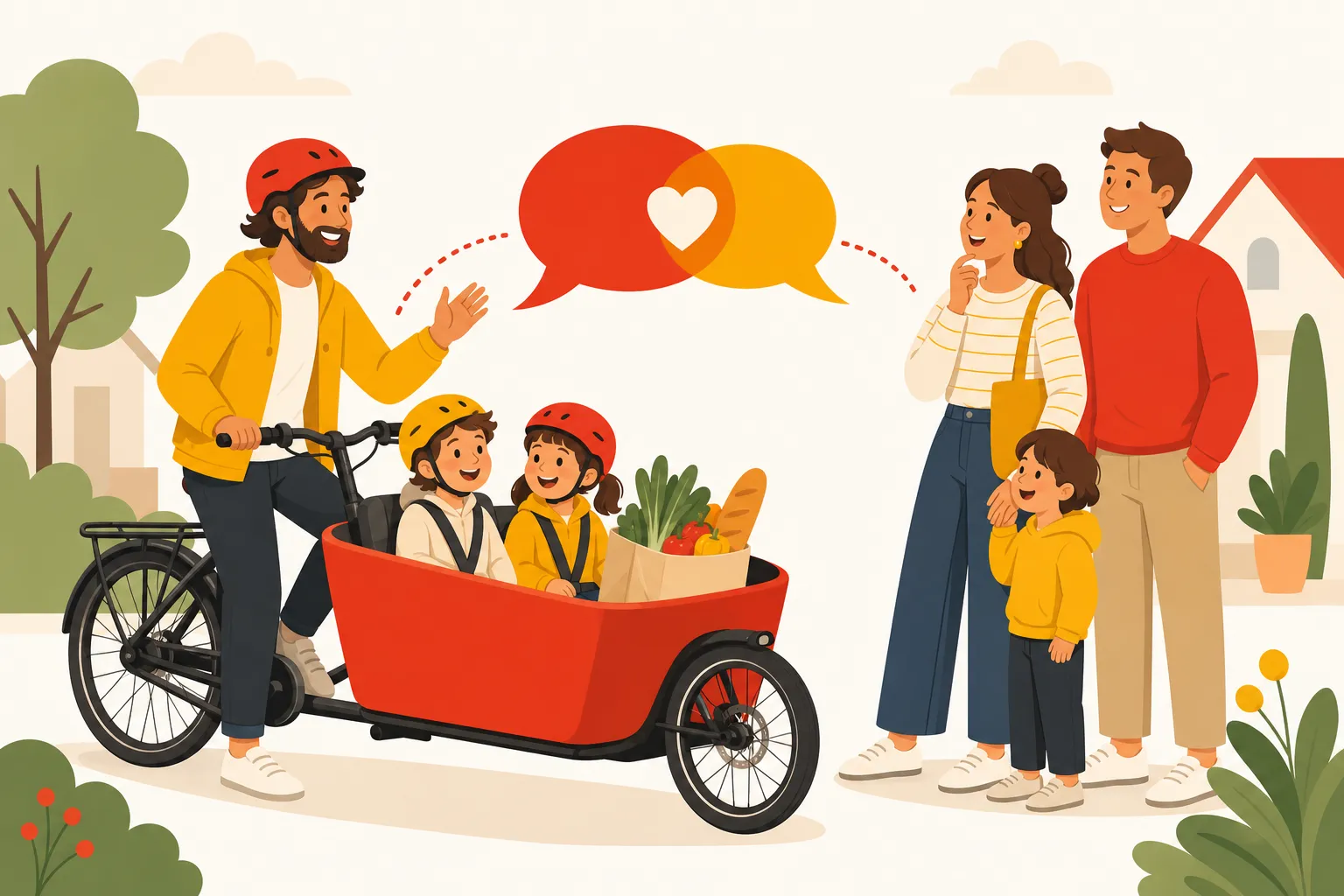
This is exactly the gap Stoked was built to close. You enroll 25 to 50 of your happiest riders as advocates and put an interactive map of them on your site. A prospective buyer browses the map, finds someone nearby (same city, same hills, maybe the same family setup), and starts a private 1:1 conversation over SMS, email, or web chat. No personal contact info changes hands. Everything runs through a privacy proxy. The conversation gets logged so you can see which chats actually drive sales.
The buyer gets to ask the embarrassing, hyper-specific question they’d never put in a contact form. The advocate, who genuinely loves the bike, answers honestly. Trust transfers from a real human to a nervous shopper. That’s the whole product. The conversation is the product, not a feature bolted onto a review widget.
The numbers from cargo bikes specifically: Bunch Bikes now attributes 40% of sales to advocate conversations. About 90% of those run fully self-serve. The typical journey from first message to test ride is about six days. Their daily admin time also dropped from 90 minutes to 20, because advocates carry the conversations the founder used to handle personally.
You reward advocates automatically (points or cash). The people doing the convincing feel valued. The program keeps running without you babysitting it.
The returns problem nobody talks about
Returns quietly wreck cargo bike economics. A returned $4,000 bike isn’t just a refund. It’s shipping both ways on a 70-pound object, inspection, refurbishment, and a unit you may never sell at full price again. A handful of returns can erase the margin on dozens of sales.
And most cargo bike returns aren’t defects. They’re expectation mismatches. The bike was heavier than imagined, the garage was tighter than measured, the hill was steeper than expected, the spouse never actually wanted it. Every one of those is a problem you could have solved before the sale with better information.
Great marketing and low returns are the same project. The honest, objection-killing content above doesn’t just convert. It qualifies. So does the advocate conversation. A buyer who talks to a real owner about their exact hill, their exact garage, their exact family setup either buys with confidence or self-selects out. Both outcomes protect your margin.
The cheapest return is the sale you never made to the wrong person. Marketing that tells the truth is returns prevention disguised as promotion.
Common mistakes that quietly bleed your budget
- Selling specs to people buying confidence. Watts and payload numbers matter, but they’re the closing detail, not the opening hook. Lead with the life the bike enables.
- Going paid-only. Ad costs climb forever and paid alone can’t close a fear-based purchase. Build owned channels and word-of-mouth that compound while you sleep.
- Treating word-of-mouth as luck. Your happiest riders are willing to help. Most brands just never build the system to let them. You only need 25 to 50 advocates to change how buyers find you.
- Hiding the trade-offs. Buyers research obsessively and trust the brand that’s honest about what the bike isn’t. Pretending you’re perfect reads as a sales pitch and gets discounted.
- Optimizing for the sale, not the fit. Chasing every conversion drives up returns and tanks your margin. Qualify hard. The right buyer is worth ten of the wrong one.
- Ignoring local. A test ride erases more doubt than a hundred ad impressions. If you can get a buyer on the bike, do it.
- Measuring the wrong things. Impressions and clicks feel productive and tell you almost nothing about a months-long purchase. Track the touchpoints that actually predict revenue. We broke down five advocacy metrics that actually matter.
Put it together
Cargo bike marketing isn’t a funnel you optimize. It’s a doubt you dismantle.
Position around the rider you serve best. Use paid to start conversations and owned content to finish them. Make content that kills specific objections instead of chasing pretty. Get people on the bike. And above all, build the system that lets your happiest riders do the convincing.
In a $4,000 fear-based decision, the most persuasive voice in the room is a real owner who already took the leap.
Do that and your returns drop. Your CAC stabilizes. Your growth stops depending on how much you can outspend everyone else.
If you want to see how peer-to-peer advocacy works specifically for cargo and e-bike brands, take a look at what Stoked does for cargo bikes or book a quick walkthrough.