How to Market a Home Gym Equipment Brand
Selling home gym equipment is hard in a way most DTC categories aren’t.
A treadmill, a power rack, a smart trainer, a cable system, a sauna, a cold plunge. These are products people put in their basement, their garage, or a spare room they’re about to remodel. They cost real money. They take up real space. And they carry real baggage: most buyers have already abandoned a piece of fitness gear at some point, and they’re terrified of doing it again.
That last part is the whole game.
When someone is about to spend $1,500 on a rower, they aren’t asking “is this a good rower?” They’re asking “will I actually use this, or will it become a $1,500 coat rack?” Your marketing either answers that question honestly or it doesn’t. Most home gym marketing doesn’t, and that’s exactly the opening for a brand willing to do it differently.
This is a founder’s playbook for home gym marketing. How to position the brand. Which channels actually pull weight. What content does the heavy lifting. Why your existing customers are your single best growth asset. And how to cut the return rate that quietly eats your margin.
Start With Positioning, Not Channels
Before you touch an ad account, get honest about who you are in a crowded market.
The home fitness space has three rough tiers. There’s the commodity tier: cheap dumbbells and folding treadmills competing on price and Amazon reviews. There’s the connected-fitness tier built around screens, subscriptions, and content libraries. And there’s the premium equipment tier: serious gear for people who want a real gym at home and will pay $1,000+ for equipment that lasts a decade.
If you’re reading this, you’re almost certainly in that third tier. Your competition isn’t the $99 bench on Amazon. It’s the buyer’s uncertainty.
So your positioning needs to answer one question loudly: “Why is this worth it for someone like me?” Not “someone.” Someone like me. The 6’4” lifter who’s tired of equipment built for average frames. The new parent who can only train in 25-minute windows. The 55-year-old rebuilding after an injury. The garage-gym purist who hates subscriptions.
Premium home gym brands win by being unmistakably for a specific kind of athlete or household, and then proving it. Generic “achieve your fitness goals” copy is invisible. Specific positioning (“built for lifters who actually load the bar,” “the only rower quiet enough for a shared apartment”) gives a prospect a reason to believe you get their exact situation.
Write your positioning down in one sentence. If it could describe three of your competitors, it’s not done yet.
Map the Channels That Actually Work for High-Ticket Fitness
Not all channels deserve equal effort. For a high-consideration, high-ticket product, this is how I’d weight them.
Paid search is your highest-intent channel: protect it
Someone Googling “best home power rack under $2,000” is close to buying. They’re not browsing; they’re deciding soon. Branded and high-intent non-branded search should be the last budget you cut. The catch: as customer acquisition cost rises across every paid channel, you can’t only live on paid search. It’s efficient until it isn’t, and competitors will bid your terms up.
Paid social creates demand, but watch the math
Meta, YouTube, and increasingly TikTok are where you create demand for a product people didn’t know they wanted in their home. Great for demonstration. Expensive for direct conversion on a $2,000 product, because the consideration window is long. Use paid social to introduce and educate, then expect to nurture before the sale closes. If your blended CAC is climbing faster than your average order value, that’s a signal to lean harder on the channels below. We wrote about escaping that trap in how to lower customer acquisition cost.
Content and SEO compound, so start yesterday
Home gym buyers research obsessively. “How much space do I need for a squat rack.” “Treadmill vs. running outside.” “Are cold plunges worth it.” Every one of those is a buyer educating themselves before they spend. If you own those answers, you earn trust and organic traffic that doesn’t get more expensive over time. More on content below.
Email and SMS close the long consideration window
Because the sales cycle is long, the brands that win are the ones that stay useful in the inbox without being annoying. Segment by where someone is: a first-time visitor who downloaded a buying guide gets different messages than someone who abandoned a $3,000 cart.
Word-of-mouth is the channel everyone underweights
The uncomfortable part: for high-ticket fitness gear, the most persuasive thing isn’t your ad. It’s a real person who already owns the thing telling a prospective buyer “yes, it fits, yes, I still use it daily, here’s a photo of it in my garage.” We’ll spend real time on this one, because it’s the most underbuilt channel in the category.
Content That Does the Heavy Lifting
For a premium home gym brand, content isn’t a blog you publish to feel productive. It’s the mechanism that removes purchase anxiety at scale.
The highest-value content answers the real objections a buyer won’t say out loud:
- “Will it fit?” Space guides, garage and basement layout content, real dimension breakdowns with a tape measure in the shot. Returns in this category are often just “it didn’t fit the room.” Solve that before the order, not after.
- “Will it last?” Build-quality teardowns, warranty explainers, founder videos walking the welds and the bearings. Premium buyers want to know they’re not buying disposable.
- “Will I actually use it?” This is the emotional core. Day-in-the-life content, realistic routines for busy people, honest takes on the learning curve. The brands that admit “the first two weeks are awkward, here’s how to push through” build more trust than the ones promising effortless transformation.
- “Is it right for me?” Comparison content, fit-by-body-type guides, use-case breakdowns. Help people self-select. The buyer you talk out of the wrong product becomes the buyer who trusts you on the right one.
Video carries disproportionate weight here because fitness equipment is physical. Show the product moving, loaded, in a normal home, not a sterile studio. User-generated demos beat polished brand films almost every time, because the buyer is imagining their space, not a set.
And resist the urge to make everything a sales pitch. The best-performing content in this category is genuinely helpful even to someone who buys a competitor. That generosity is what makes it shareable, linkable, and trusted.
Your Existing Customers Are the Most Persuasive Asset You Have
Now the part most brands underuse.
A prospective buyer staring at a $2,500 piece of equipment has a trust problem. Your marketing department cannot solve it alone. Every word you publish is suspect by default. You’re the seller. Of course you say it’s great.
But the person who already bought it? They have nothing to sell. When a buyer-in-waiting hears “I’ve had this rack for three years, it’s bombproof, and here’s how I fit it in a one-car garage,” that single sentence does more than a month of ads. It’s the oldest form of marketing there is, and the hardest to scale. We dig into why over-relying on the alternative fails in why real conversations beat reviews for high-ticket DTC.
Most brands try to capture this with reviews, and reviews are fine, as far as they go. The problem is they’re one-directional. A five-star review can’t answer “I’m 5’2”, will the pull-up bar height work for me?” or “how loud is it really if my kid’s asleep upstairs?” The specific, weird, personal question (the one actually blocking the sale) goes unanswered. And the buyer walks.
This is the gap peer-to-peer brand advocacy is built to close.
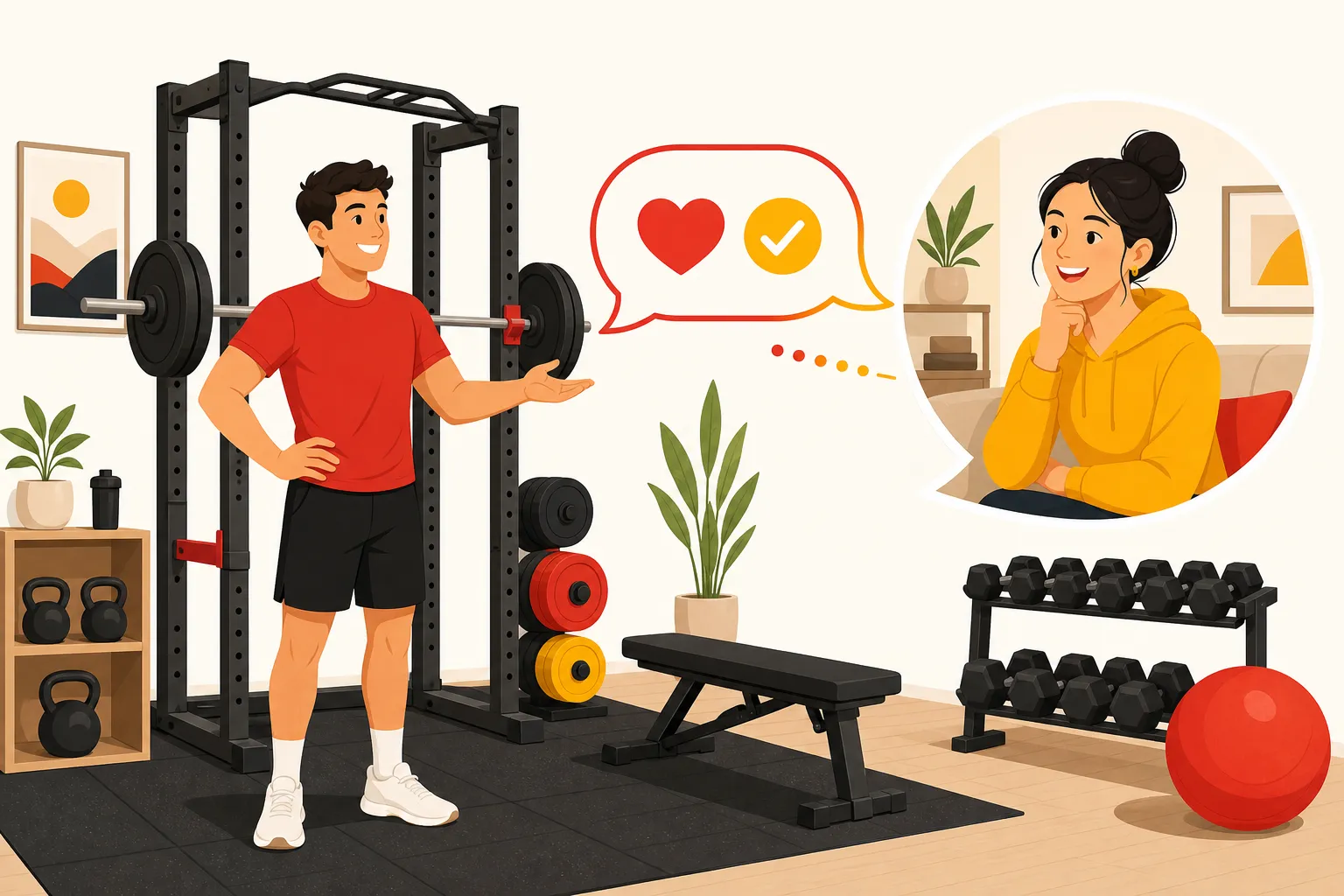
The idea is simple: connect a prospective buyer with a real, existing customer for a private one-to-one conversation. Not a forum. Not a review wall. An actual back-and-forth where the buyer asks their specific question and a real owner answers it, over text, email, or web chat. The conversation is the product. Everything else exists to make that human moment happen reliably.
That’s what we built Stoked to do, and it’s the model behind our home gym vertical. A brand enrolls its 25–50 happiest customers as advocates. Prospective buyers browse an interactive map on the brand’s site. They find an owner near them, or one who matches their use case, and message them directly through a privacy proxy. No personal contact info ever changes hands. Advocates get rewarded automatically (points or cash) for showing up. The brand sees, from an admin dashboard, exactly which conversations drove sales.
The proof that this isn’t theory: Bunch Bikes is a premium cargo e-bike brand. Also a high-ticket, high-consideration, “will-this-fit-my-life” purchase. They drove 40% of their sales through advocate conversations. Daily admin time dropped from 90 minutes to 20. About 90% of conversations were fully self-serve. The founder didn’t have to babysit them. Home gym equipment shares the same buying psychology, so the model translates cleanly.
If you want to measure whether it’s working rather than take it on faith, we laid out the framework in five metrics that actually matter for advocacy impact.
Reducing Returns Is a Marketing Problem (Mostly)
Returns are where home gym brands quietly bleed. A returned treadmill isn’t just a refund. It’s freight both ways, restocking, sometimes a write-off on a damaged unit. A few points of return rate can erase a quarter’s margin.
And most returns in this category aren’t quality problems. They’re expectation problems. Marketing oversold, undersized, or under-explained, and buyers found out after the box arrived.
The fix is mostly pre-sale:
- Be ruthlessly honest about dimensions, noise, weight, and assembly. Surprise is the enemy. Every unpleasant surprise after delivery is a candidate for return.
- Set realistic expectations about the experience. If there’s a learning curve, say so. Buyers who know the first weeks are awkward stick it out. Buyers who were promised magic bail.
- Help people buy the right thing the first time. Fit guides, sizing tools, and honest comparisons reduce the “wrong product” return entirely.
- Let buyers talk to owners before they purchase. This is where advocacy pulls double duty. A prospect who asks an owner “is this realistic for someone my size in a space my size?” and gets a straight answer buys with confidence, and confident buyers return far less. The conversation that closes the sale is often the same conversation that prevents the refund.
Marketing that tells the truth costs you a few sales up front. It saves you the far more expensive ones on the back end.
Common Mistakes That Quietly Cap Your Growth
A few patterns I see over and over in this category:
Competing on price instead of trust. If you’re premium, racing the commodity tier to the bottom destroys your positioning and your margin. Win on confidence, not on coupons.
Treating reviews as the finish line. Reviews are the baseline, not a strategy. They build a floor of credibility; they don’t answer the specific question blocking a specific sale.
Pouring everything into paid acquisition. When CAC is the only lever, every competitor with a bigger ad budget out-spends you. Build channels that compound (content, SEO, and word-of-mouth) so you’re not renting all your growth.
Ignoring the customers you already have. Your happiest buyers are a marketing engine sitting idle. Most founders simply never ask them to help. You don’t need thousands of advocates. You need 25–50 people who love the product and are willing to answer a question now and then.
Hiding the hard parts. Assembly, footprint, noise, the learning curve: buyers find out anyway. Telling them first is a trust advantage, not a liability.
The Playbook in One Breath
Pick a sharp position for a specific buyer. Defend your high-intent search. Use paid social to introduce and educate, not to brute-force conversions. Build content that answers the real, unspoken objections, and keep it generous enough to share. Then activate the asset everyone else leaves on the table: your existing customers, having real conversations with the people deciding whether to buy.
For a high-ticket, will-this-fit-my-life product, the most persuasive thing in your marketing isn’t a thing you say. It’s a real owner saying it for you. That’s the whole reason word-of-mouth has always been the most trusted channel (see what word-of-mouth marketing really means) and the reason it’s worth building deliberately instead of hoping it happens.
If you want to see what that looks like for a home gym brand specifically, take a look at the home gym solution or grab a demo and we’ll walk you through it.